Build beginner strength with resistance bands at home
If you want to get stronger but are new to resistance training, a band gives you a simple way to practise at home. Start with manageable tension, learn a few full-body movements and increase the challenge gradually.
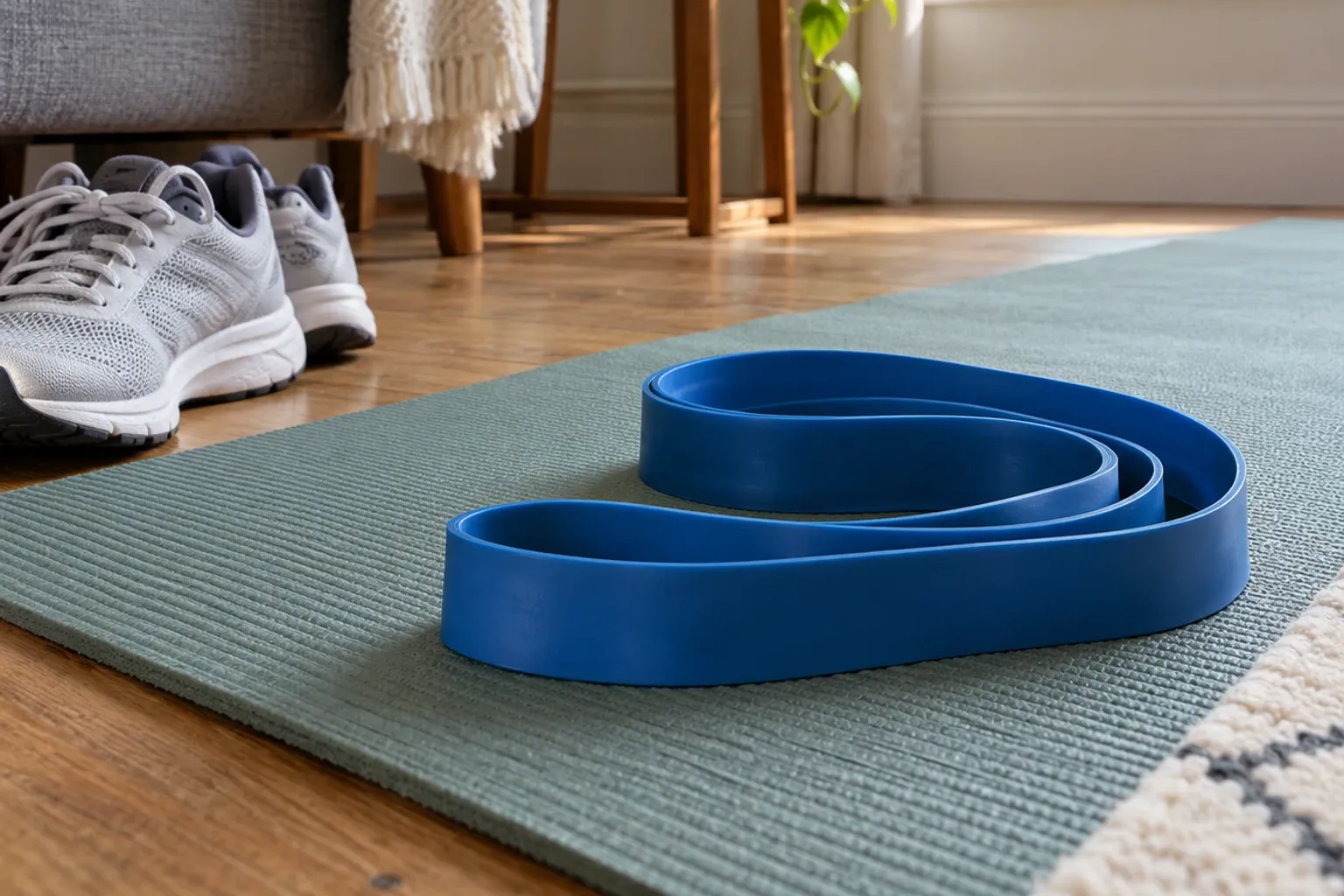
Starting strength training can feel like a big commitment when you are unsure what equipment to buy or how to use it. Resistance bands are light, portable and can be used for a range of movements, but the right routine still needs to challenge your muscles without making you lose control of your form. Begin with a band you can move smoothly, work your major muscle groups and leave time to recover. The routine below is for general beginner strength, not a running-specific programme.
What should a beginner look for in a resistance band?
A resistance band creates tension as you stretch it, so your muscles work against that resistance. Bands come as long strips, loops or handled tubes, and their resistance varies. You do not need to start with a large set: one band that lets you complete a controlled movement is enough to learn the basics. The British Heart Foundation explains that the band should stretch enough to let you complete the movement while still creating tension you can feel in your muscles. Its home exercises use a long elastic band, but the best choice depends on the movement and your current strength.
Check the band before each session for splits, thin patches or damage, and use it according to its instructions. For exercises where you stand on the band, place it securely beneath your foot and check that it cannot slip. Avoid pulling it towards your face, and keep your grip firm. If you are anchoring a band to a fixed point, use an attachment designed for that purpose and check that it is secure before pulling. Do not improvise with a door handle or other fitting that might move.
A band should make the last part of a set feel challenging, but it should not force you to jerk, twist or shorten the movement. You can alter tension by changing your grip or stance: holding the band shorter usually makes it harder, while allowing more length makes it easier. If form goes as soon as you increase tension, ease off. That is a useful adjustment, not a failed workout.
How does band training compare with other ways to get stronger?
Resistance bands, weights and bodyweight exercises can all provide resistance for strength work. Bands are compact and let you adjust tension through your grip and range of movement. Weights provide a more direct way to add load, while bodyweight movements need no equipment. You can use any of these; the practical choice is the one that allows you to practise consistently and control the exercise.
Bands do not have a single fixed weight printed on them that tells you how hard every exercise will feel. Tension changes as the band stretches, and your grip length, body position and movement all affect the effort. A band that feels manageable for a seated row may feel too strong for an overhead movement. Choose resistance separately for each exercise rather than assuming one colour or level will suit your whole routine.
For general adult activity, the NHS recommends muscle-strengthening activities that work all the major muscle groups on at least 2 days a week. It also advises adults to aim for 150 minutes of moderate-intensity aerobic activity or 75 minutes of vigorous activity weekly; strength sessions do not automatically count towards that aerobic target. The NHS adult activity guidance treats these as complementary parts of an active week. If your goal is a first running event, you can fit general strength sessions around the running progression in your plan to build fitness for a first running challenge.
What beginner routine can you do with a band?
Start with a brief, comfortable warm-up, such as marching on the spot and moving your arms through an easy range. Then try this full-body session. The exercises use a long band; adjust the tension so each repetition stays controlled. A repetition, or rep, is one complete movement. A set is a group of repetitions performed before you rest.
- Chair squat: Stand in front of a stable chair, feet about hip-width apart. Sit your hips back towards the seat, then stand by pressing through your feet. Begin without a band if needed; add a band under both feet and hold its ends at your sides only when you can control the movement.
- Seated band row: Sit tall with legs extended or softly bent. Loop the band around your feet, hold an end in each hand and draw your elbows back. Keep your shoulders relaxed, then return your hands forward slowly. If the band could slip off your feet, choose another exercise or setup.
- Chest press: Hold the band behind your upper back, with an end in each hand. Press your hands forwards until your arms are nearly straight, then return under control. Keep the band away from your neck and stop if the setup feels unstable.
- Biceps curl: Stand on the middle of the band and hold an end in each hand. Keep your elbows near your sides as you bring your hands towards your shoulders, then lower them slowly. Use less tension if you need to swing your body.
- Hip abduction: For a loop band, place it around your legs above the knees and sit near the edge of a stable chair. Keep your feet planted and gently press your knees apart, then return. A lighter band or a smaller movement makes this easier.
- Standing band pull-apart: Hold a light band in front of your chest with both hands. Keeping your arms long but not locked, draw your hands apart, then slowly return. Stop before your shoulders shrug or your back arches.
For your first sessions, try one set of each movement and focus on learning the positions. The NHS suggests 8 to 12 repetitions as a set and at least 2 sets of muscle-strengthening activities, with 3 sets an option for greater benefit. Those are general targets, not a test you must pass on day one. A beginner can build towards them gradually. The NHS strength and flexibility guidance also says to start gradually over a period of weeks and work the major muscle groups.
Breathe throughout each repetition rather than holding your breath. Move steadily in both directions; the return matters too. Rest long enough between sets to regain control and repeat the movement without rushing. If you cannot keep a comfortable position or finish a set without changing your technique, shorten the set, reduce the band tension or choose an easier version.
How can you fit sessions into a week and progress?
A workable starting pattern is two non-consecutive strength days in a week, leaving at least a day between sessions so the same muscles have time to recover. The British Heart Foundation suggests doing its band exercises 2 to 3 times a week with at least a day between sessions. Its resistance-band exercise advice also recommends reducing resistance if a movement is too difficult to complete with good form. If you are also running or doing another sport, place the sessions where they do not leave you too tired to move well in your other training.
When a set feels controlled from the first rep to the last, and you could comfortably do more, increase the challenge a little. You might hold the band slightly shorter, use a stronger band or add a set, but do not change all three at once. Keep the range of motion comfortable and make sure you can still lower the band smoothly. A simple note of the exercise, band and reps helps you spot when a movement is becoming easier.
If you have not exercised for some time, have a medical condition or are unsure what is suitable, check with your GP before starting; the NHS recommends this for adults with concerns or health conditions. Stop if you feel unwell, experience pain that is sharp or worsening, or cannot control the band. For heart conditions or high blood pressure, seek advice before starting band exercises. If you are building towards a race, general band work is only one part of preparation; choose running sessions through a beginner running plan and use a simple strength routine for runners when you want strength work specifically matched to running.
Frequently asked questions
How do I know whether my resistance band is too hard?
If you cannot complete the movement smoothly, keep your posture steady or control the return, choose a lighter band or reduce the stretch. If the band feels easy throughout and your muscles are not working noticeably by the end of the set, try slightly more tension. Change one thing at a time, such as your grip distance, so you can tell whether the adjustment helped.
Can I use resistance bands if I have high blood pressure?
Ask your GP or healthcare team before starting if you have high blood pressure or a heart condition. The British Heart Foundation specifically advises people with either to check before beginning its resistance-band exercises. If you have recently had surgery or have another health concern, get advice about suitable movements and effort rather than assuming a general beginner routine is right for you.
Can band exercises replace running or walking?
Band training is a way to strengthen muscles; it does not automatically replace aerobic activity such as running or brisk walking. The NHS lists muscle-strengthening work separately from its weekly aerobic activity targets. You can do strength and aerobic exercise on the same or different days, depending on what fits your routine and how you recover.